Wednesday, March 08, 2006

Aussies to retrace Sandakan death march track


MELBOURNE: A group of Australian Defence Force personnel will retrace the infamous Sandakan death march track where almost 2,000 Australians lost their lives during World War II, beginning March 15.

The party will be led by historian and investigative writer Lynette Silver, who was responsible for rediscovering the path. It will embark on a six-day trek from Bauto across the mountains to Ranau, a distance of about 150km.

“Lost behind impenetrable jungle in Borneo for the past 60 years, the Sandakan death march track, where Australian and British prisoners of war died amid unimaginably cruel conditions, has been identified,” said Silver, who spent the past 14 years researching the Sandakan PoW camp and the resulting death marches.

“Almost 2,000 Australians lost their lives in Sandakan and in the resulting three death marches in 1945 across Borneo’s rugged interior, where Japanese captors forced ailing Australian and British soldiers to walk a 250km trail.

“My hope is that the Sandakan track will become as much a part of Australia’s ethos as the Kokoda Trail in Papua New Guinea and Gallipoli in Turkey,” she said.

Silver added: “The atrocities suffered by Australians and their allies in Sandakan should never be forgotten. Their heroism, sustained over a three-year period, was extraordinary and certainly equals that exhibited on any battlefield,”

She has combined forces with Tham Yau Kong, Sabah’s leading trekking expert, to locate and re-open the original death march track.

Silver rediscovered the track’s route using a highly detailed hand-drawn map

- the only known and complete map in existence given to her by a member of the 1945 body recovery team — and by plotting the location of every PoW body recovered along the entire track.

The first section of the route, from Sandakan to Bauto, can also be followed, but now passes entirely through oil palm plantations.

The project to re-open the track has the backing of the Malaysian and Sabah governments and the general manager of Sabah Tourism, Datuk Irene Charuruks.

On March 15, Silver and Tham will accompany a group of Australians, including a relative of one of the original prisoners of war and nine members of the Australian Defence Forces.

They will be the first people to walk in the footsteps of the PoWs since Australian Army recovery teams searched for bodies in 1946. Silver will be the first woman to follow the path.

The original route, cut by locals and purposely made as difficult as possible in the belief that it would be used solely by Japanese troops, passed almost entirely though uninhabited areas.

Once the war was over and bodies retrieved, the jungle obliterated all traces of it. An attempt was made by local trekkers in the 1950s to locate the route, without success.

For more information check www.sandakan-deathmarch.com.

Source: Bernama

Tuesday, March 07, 2006

Brunei-Sabah tour package 'the best formula'


Kota Kinabalu: Brunei supplied a total of 58,544 visitors to Sabah in 2005 while Royal Brunei Airlines (RBA) can play an even

bigger role to help Sabah tap a growing China market, local operators said.

Two local tour operators here alone reported getting close to a thousand Chinese tourists per month from Shanghai, Guangzhou

and Hong Kong via Brunei and RBA.

"We are now getting a few hundred Chinese tourists each month and RBA's connecting flight and the China market must go

together," said Vivian Lee, Executive Director of Mt Kinabalu Adventure Tours.

Giving reasons, she said: "Chinese visitors want to see Brunei because it is famous - being the smallest yet the richest

Muslim country in the world."

Yet Sabah has the more to gain because most Chinese choose to stay two nights in Sabah in a three-night/four-day package,

since Brunei at night is generally quiet, she said.

"And of mainland Chinese, Hongkongites and Taiwanese, the spending power of mainland Chinese is better," Lee noted.

Eddy Chan of Tai Kar echoed generally the same story. "RBA flies four times a week to Shanghai and every month we get about

400 Chinese tourists stay a night at deluxe Hyatt in Brunei and come stay three nights in Sabah on a five-day/four-night

package," said Chan.

"My groups use RBA every flight," he added.

Since Brunei has hundreds of years of historical dealings with China and now enjoys world fame for its oil wealth, it is

well-known in China.

"We find the best way to sell Sabah in China market is the two-in-one formula, that is, a Brunei/Sabah package," said Judy

Ngui Siok Choon, RBA's Acting Sales Manager Sabah.

Brunei's Ministry of Tourism has for some years promoted Sabah together with Brunei.

Believing RBA can be of greater help for mutual benefits in the years ahead, Ngui said the airline recently staged an

awareness drive with Wisma Merdeka based on a Chinese New Year lucky draw.

"All shoppers who bought RM50 or more goods and services were eligible for a lucky draw," Ngui said.

First prize-winner was Heng Mui Kiow who won a return air ticket to Hong Kong, while Au Sok Goh won a return air ticket to

Brunei.

Since RBA flies to Perth, Brisbane, Sydney and Darwin, it is a key deliverer of Australian tourists to Sabah, especially from

Perth, Ngui said.

It also brings in good number of Britons from London, especially Saga Holidays guests.

It flies to KL and Singapore daily, Manila five times a week, Hong Kong six times, London daily, Frankfurt four times,

Auckland, New Zealand, three times and other regional destinations such as Bali, Surabaya, Jakarta, Ho Chi Minh City, etc.

Courtesy of Borneo Bulletin

Monday, March 06, 2006

New Package: 3D/2N Kuching Leisure Tour


If you missed out on our new short tour package announcement via our Borneo Tour Package Alert Blog last week, please do take a look at our latest 3D/2N Kuching Leisure Tour at the following URL:

Sunday, March 05, 2006

More turtles returning to Sipadan Island


KOTA KINABALU: More turtles are returning to the diving haven of Pulau Sipadan after a move to limit visitors was made.

State Secretary Datuk K.Y. Mustafa said Sabah Parks personnel recorded 507 turtle landings between April last year and February this year.

Of these, 502 were green turtles that laid nearly 46,000 eggs. Five were leatherback turtles which laid 502 eggs.

“More than 17,000 of the eggs have hatched,” Mustafa said during a visit to Sipadan two days ago.

He said since the government decided to demolish all resort accommodation on the island and to limit the number of visitors to 120 per day, more trees and other plants have grown.

Mustafa said that to ensure better management of the island, he would meet various agencies and tourism companies involved in taking divers to Sipadan.

“Ultimately, we want to see a more co-ordinated entry of tourists and divers to Sipadan,” he added.

On security on Sipadan, where 21 tourists and resort workers were kidnapped and held in the southern Philippine island of Jolo for six months in 2000, Mustafa said he was satisfied with the measures in place.

Sabah Parks director Datuk Lamri Ali said a tourism centre would be built on the island over the next few years.

Source: The Star

Saturday, March 04, 2006

Red ape of Tasek Merimbun, Brunei

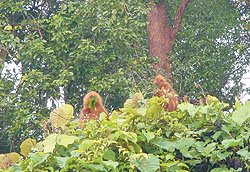
Two adult Maragang feeding hungrily on young leaves of Merremia peltata
just next to the dormitory. Photo & Copyright: Hj Ramlee
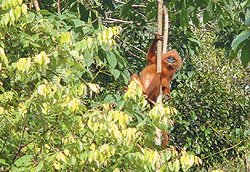
An adult Maragang or Maroon Langur reacts with its classic posture.
Photo & Copyright: Hj Ramlee

By Meiji and Hj Bahrin HB

At a glance one could have stumbled upon a red primate in the countryside or interior believing it was an Orangutan. On record, perhaps the most reliable encounter of a solitary Orangutan was claimed by Awg Hj Pudin bin Zainal who said he saw one at Selangan forest, in Temburong way back in 1923. His description of the primate - red fur, no tail, a bit bigger than other primates found here in Brunei Darussalam, does not jump but moves and swings most of the time from tree to tree - is most likely to be the last red ape seen in the wilderness of this country.

But what has happened then?

Nobody had seen such an ape since. Could it be that the rare sighting was of another red primate - the Maragang (the species of Presbytis rubicunda meaning red langur)? However, the Maragang which has a similar coloration with a long tail and of which the dominant males live with a harem do not occur in that part of the lowland Temburong forest except in the mountain ranges of Bukit Retak and Gunong Pagon.

Where else can you see this red ape?

The Maragang (which also means red in the native Dusun language) or commonly known as Maroon Langur (for its reddish to golden brown furs) is not found in Brunei-Muara district either. Rapid development has immensely changed the natural landscape into less diverse fragmented forest habitats that could have been the main factor which pushed them further inland in the Tutong and Belait districts. There are now several harems living around Tasek Merimbun Heritage Park Centre. One of the harems is often seen just next to the dormitory inhabited by a few of the Brunei Museum staff.

There are two distinct groups of monkeys in Borneo; the langurs or leaf monkeys and the Proboscis Monkey and the macaques. The Langur consists of five species; Presbytis hosei, Presbytis frontata, Presbytis cristata, Presbytis melalophos and Prebytis rubicunda. Three of the species are found in Brunei Darussalam, they are Presbytis hosei, Presbytis cristata and Presbytis rubicunda. The later two species are found in Tasek Merimbun.

The Maragang has a dark face or a bluish tinge. The adult's head has a cone-shaped hood fur that an Orangutan does not have. The infants are whitish with black markings down the back and across the shoulders. Still clinging to their mum's shoulder since their birth, the infants then transform into a reddish coloration after about six months old. They learn to move independently after about one year but always staying close to their mums and enjoying the company of their other younger siblings. They usually live with a group of about eight with only one adult male.

Researchers have found that the Brunei group size is slightly richer than that of the neighbouring countries and this could be due to the healthy and well-maintained ecosystem in its natural state. In Tasek Merimbun, the known habituated group size consists of ten individuals. They spend their night on tall trees preferably an emergent.

The Maragang feeds throughout the day mostly on young leaves of both primary and secondary forests, but they also known to come down to certain tree plantations and gardens to eat young leaves and seeds. In Tasek Merimbun, the Maragang feeds on young leaves, flowers and as well as fruits of the species Merremia borneensis, Merremia peltata, Koompassia malaccensis, Havea brasilensis, Dillenia suffruticosa, Plectomia mulleri, Uncaria sp and other species from the families of Myrtaceae, Oxalidaceae, Urticaceae and Moraceae. They even feed on poisonous young leaves of the Parartocarpus venenosus.

This red primate is listed in the IUCN Red Book, meaning they are endangered and are legally protected worldwide. Their occurrence in most conservation areas of Brunei Darussalam provides a better chance of their longterm survival particularly at Tasek Merimbun that has been declared as one of the most outstanding ASEAN Heritage Parks since 1984.

The Maragang in Brunei Darussalam have always been very fortunate because indigenous people do not eat or hunt them and they never been considered as pests. Primate enthusiasts or visitors who may wish to enjoy seeing this red primate could seek advice from the managers of the park for further sighting schedules.

Courtesy of Borneo Bulletin Weekend