Wednesday, May 03, 2006

New 5-star Brunei hotel aiming for MICE market

Brunei Hotel Rizqun International Hotel's grand deluxe room.
Photo © Borneo Bulletin


By Azlan Othman

Brunei's newest 168-room Rizqun International Hotel is aiming to lure meeting and international convention and exhibition (MICE) market and incentives more than the leisure market.

"Being right in the heart of Gadong is the strength of this jewel. However, the plus point of the five-star hotel is the grandeur of its interior, state of the art technology of its function, meeting room and ballroom which can cater more than 1,000 guests in one seating in a banquet," said its General Manager, Muhammad Irwan Goh, in an interview with the Bulletin.

"Opened for business on May 1, the hotel, which employs some 85 to 90 per cent locals, is furnished with LCD television and DVD players in every room of the eight-floor hotel. The grand deluxe room has two bathrooms. There are also five Duplex suites priced at $1,700 with two floors and two separate bedrooms.

Executive Club, the biggest in town, houses two floors. A dome on the eighth floor is suitable for private gathering including barbecue. A lot of attention has also been paid to the room's door design, he added.

Muhd Irwan, who has a vast experience in the hotel industry having worked in this line for 24 years including 2 years at Berjaya Lemome beach resort hotel in Mauritius, 10 years in Singapore including Dynasty (now Marriot hotel) and Oriental and countless hotels in Malaysia, shared his view on how to market this hotel.

"Of course, it's a different clientele, operation methods, and marketing concept. It's a challenge to position the hotel, considering Brunei's budding tourism industry. To really go into leisure market is a challenge.

"But we position ourselves and focus on meeting and international convention and exhibition (MICE) market, noting that July is a busy period for the hotel. Brunei is a good destination for MICE and incentives."

From deluxe to presidential suites, the hotel also has executive club floor on the 7th and 8th floors. Suites namely premier, ambassadors and presidential are on the 8th floor.

Being a member of a club means guests are entitled to a host of amenities including evening mocktails, complimentary laundry and other value added services.

Asked on the price range, there is a difference of $100 between deluxe and executive clubrooms. For example, the normal deluxe room is $280, so the deluxe room in the executive club is $380.

The presidential suite is priced at $3,500. Currently, the hotel has a promotion for deluxe, grand deluxe and executive deluxe, one bedroom and two bedroom suites.

During the promotion, which the hotel is offering till the end of August, the discount is 50 per cent, ranging from as low as $150 per room per night with breakfast for two persons.

Asked his view on the country's hotel occupancy rate, Muhd Irwan said it will be maintained at 30 to 35 per cent this year and next year and doesn't think that it will go beyond that.

Courtesy of Borneo Bulletin

Tuesday, May 02, 2006

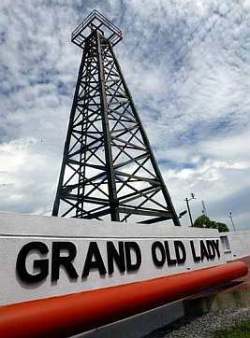
Miri owes a lot to the “Grand Old Lady"

PROUD LANDMARK: Although she was built in 1910,
the Grand Old Lady of Miri is still standing tall today.
Bernamapic © Bernama


MIRI: She stands majestically perched on top of Bukit Telaga Minyak, better known among the locals as Canada Hill, overlooking this town and the rapid development which had taken place over the last 96 years.

Dubbed the “Grand Old Lady,” she is not a frail figure of an old woman but Miri’s Number 1 oil well, the first cable tool oil well in the country.

Since 1910, the Grand Old Lady had witnessed various historic and physical developments in this oil-rich town, which now is not only known for the “black gold” but also its attractive tourism industry.

It is believed that this well produced the first oil found in the country on Dec 22, 1910 and continued pumping out the precious commodity for the next 62 years producing 658,650 barrels of oil before it was closed on Oct 31, 1972.

Due to its sentimental value, the Sarawak government on July 10, 1985, restored the Grand Old Lady and accorded her status as one of the state’s important historical monuments.

The Grand Old Lady dates back to the late 1800s when the then Baram Resident, Claude Champion de Crespigny discovered there was oil in the Baram region.

Centuries before he noted this, the indigenous people living in and around Baram region had been using the oil as fuel, calling it minyak tanah.

In 1888, Charles Hose who took over as the subsequent Baram Resident continued Crespigny’s work and before retiring, Hose did another intensive study about the presence of oil there.

Soon after retiring, Hose requested permission from the then Sarawak White Rajah Sir James Brooke to present his studies to the AngloSaxon Petroleum Company in London.

In 1909, Hose returned to Miri, this time bringing along geologist, Dr Josef Erb, and after a series of studies the expert was convinced that the Baram region including areas surrounding Miri was rich in oil.

Dr Erb then decided to build an oil well on top of the hill and a Canadian, by the name of McAlpine, was assigned to erect the well. The hill was named Canada Hill, honouring his contribution.

On Aug 10, 1910, McAlpine successfully completed an 87m high wooden tower now known as the Grand Old Lady.

After months of drawing blanks, they struck oil on Dec 22, 1910 at a depth of 150m.

Due to the sentimental value of the Grand Old Lady to Miri, a Petroleum Museum was built next to it and the name Canada Hill was changed to Bukit Telaga Minyak in 2005.

The museum was opened on May 20, last year by Chief Minister Tan Sri Abdul Taib Mahmud, and the opening coincided with Miri being accorded city status.

Source: BERNAMA

Monday, May 01, 2006

Tip of Borneo - Lure of land’s end in Sabah

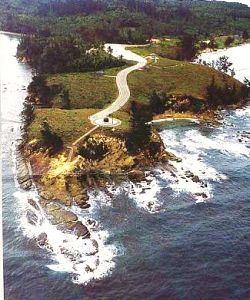
Kampung Simpang Mengayau, the tip of Borneo island.
File photo © Bernama
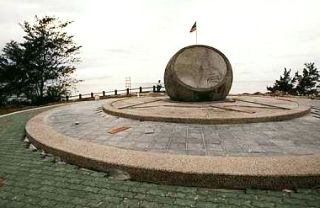
The Globe – landmark for Simpang Mengayau in Kudat.
File Photo © Bernama

By NASRIAH DARUS

Standing on the majestic cliffs of Tanjung Simpang Mengayau (i.e., the Tip of Borneo Island) gives visitors a feeling of being at the edge of the world. As the sun sets over the horizon at this northwestern tip of Borneo, the world’s third-largest island, visitors are enchanted by the glittering turquoise sea and the sky’s tinges of red and gold.

Breathtaking and awe inspiring” are apt words to describe the feeling when one stands on the majestic cliffs at Tanjung Simpang Mengayau, dubbed the “land’s end of Borneo”.

As the sun sets over the horizon at this north-western tip of the world’s third largest island, visitors are enchanted by the glittering turquoise sea and the sky’s tinges of red and gold.

“When one stands on the cliff and looks out to the open sea, it is like standing on the edge of a world, looking at mother nature’s greatness and the scene is simply awesome,” an adventure seeker once wrote in a travel magazine.

Visitors to Tanjung Simpang Mengayau, located some 170km from Kota Kinabalu, will agree with the writer’s comments.

Boredom and exhaustion from the three-hour car ride from Kota Kinabalu easily dissipate after hearing the cacophony of waves splashing against the rocks at the bottom of the cliffs and enjoying the view of miles and miles of the blue-green sea.

Tanjung Simpang Mengayau, a 30-minute drive from Kudat, is among the must-see spots that exude breathtaking panoramic vistas for tourists.

The meeting point of Laut Sulu and South China Sea, it is called Tanjung Sampang Magazo in the Rungus dialect, meaning “a junction where a battle took place”.

Rungus folklore tells of a story where warriors made a stand against invading pirates, hence the name of this headland.

According to historians, Spanish seafarer Ferdinand Magellan, on his way to circumnavigate the globe, had stopped there for 42 days for repairs to his ships. Tanjung Simpang Mengayau is indeed among Sabah’s many world-renowned natural wonders.

With its crystal-clear seas, magnificent beaches, islands, coral reefs as well as its lush forests, wetlands and majestic mountains, Sabah showcases an outstanding array of biodiversity.

Kudat district has some of Sabah’s finest beaches, offering holiday goers peace and tranquillity.

In Kudat, Kampung Bavanggazo is known for its Rungus longhouses. Kampung Sumangkap, on the other hand, is a gong-making village while honeybees are synonymous with Kampung Gombizau.

Kudat is also the home of the Rungus, where many still live in longhouses and observe age-old customs and traditions

Kudat is also a seafood paradise as there are plenty of fishing villages there.

“You can buy fresh crabs, prawns, fish and shellfish here and had have it cooked at beachfront stalls or restaurants,” said one government official.

Kudat was Sabah’s first state capital and fast turning into a tourism spot.

The town attracts many travellers from China, Taiwan and Australia with some coming back to acquire property along the beachfront under the “Malaysia, My Second Home” programme.

Sabah’s other leading tourism destinations are its underwater realm in Pulau Tiga, Tunku Abdul Rahman Marine Park as well as the islands of Mantani, Lankayan, Mabul and Sipadan which draw many snorkelling and scuba diving enthusiasts.

Source: BERNAMA

Also read:

Tip of Borneo - Symphony performance under full moon


KOTA KINABALU: This year’s Sunset Symphony in Tanjung Simpang Mengayau or the tip of Borneo in Kudat on May 13 will be performed against a background of not only swaying coconut trees and the setting sun but also under the full moon, Sabah Tourism Board chairman Tengku Datuk Zainal Adlin said.

He said that nowhere in the world had an orchestra performed under coconut trees, and the performance at such an unconventional venue would be an unforgettable experience not only for the Kota Kinabalu Symphony Orchestra (KKSO) but also the audience.

“May 13 this year coincidentally holds a special significance as not only will KKSO perform against the backdrop of the setting sun but also the rising glorious full moon. This full moon only occurs on the 13th of May every 19 years,” he said.

This will be the second performance by the two-year-old KKSO, the only musical ensemble in Sabah, at the meeting point of the South China and Sulu seas, after last year’s successful performance attended by about 500 people.

He said that KKSO, an ensemble of 100 young and aspiring musicians, mostly primary and secondary schoolchildren under the leadership of Liaw Liam Thye, had performed extensively in Kota Kinabalu since its inception in 2004.

This year’s event, led by music conductor Yap Ling, a versatile Malaysian musician and talented violinist, is set to enthral the audience with a variety of classical favourites and popular Kadazandusun, Malay, Chinese and English songs, he said.

The guests will include Datuk Ooi Chean See, the outgoing Resident Conductor of the prestigious Malaysian Philharmonic Orchestra and Deputy Chief Minister and state Tourism, Culture and Environment Minister Tan Sri Chong Kah Kiat.

Source: BERNAMA

Colourful Launch For Sabah Harvest Festival


KOTA MARUDU -- Sabah Deputy Chief Minister Datuk Seri Joseph Pairin Kitingan cut seven stalks of padi and then pounded rice seven times with a wooden pestle to symbolically launch the month-long celebration of Kaamatan or Harvest Festival.

Pairin represented Chief Minister Datuk Seri Musa Aman at the colourful event.

Also present were Minister in the Prime Minister's Department and Bandau MP Datuk Dr Maximus Ongkili and state Industrial Development Minister Datuk Ewon Ebin.

More than 10,000 people turned up for the ceremony to appease the "bambarayon" or rice spirits performed by more than 20 "boboliyan" (priestesses) led by Maugirus Lomidang, 62.

Model houses of ethnic groups in Kota Marudu were built to show visitors the local culture and way of life.

In conjunction with the festival, traditional games and competitions like the "sugandai Kaamatan" singing contest and "Unduk Ngadau" or beauty pageant were held.

Source: BERNAMA