Sunday, May 14, 2006

Cloudy skies mar Sunset Symphony but ensemble plays on

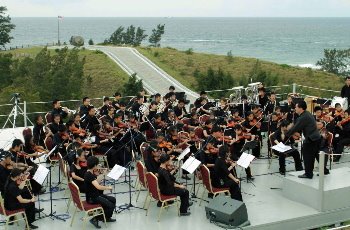
NO STOPPING US NOW: The orchestra playing under the windy condition as the sun sets and the moon rises.


By Jaswinder Kaur

KOTA KINABALU, SABAH, SUN: CLOUDY skies marred the Sunset Symphony at the northernmost tip of Borneo at Tanjung Simpang Mengayau, Kudat, yesterday, but the Kota Kinabalu Symphony Orchestra played on.

It was the 100-person ensemble’s second performance at the venue, playing under the setting sun as well as the rising moon. This year’s event was special, as the rising moon, also known as the Flower Moon, was believed to be at its best in 19 years.

Despite strong winds and the cloudy skies having obscured the view of the setting sun and the rising moon, the ensemble enthusiastically played classics such as "Dengarlah Sang Ombak Berdesir" from P. Ramlee's film Penarik Beca.

Sabah Deputy Chief Minister Tan Sri Chong Kah Kiat, who is also Tourism, Culture and Environment Minister, was at the venue to welcome guests – NST pix by Edmund Samunting.

Courtesy of New Straits Times

Tip of Borneo's musical experience like no other

THE sounds of music and songs reverberated through the breathtaking Tip of Borneo, against the backdrop of sunset, captivating some 1,500 people, on Saturday.

On a special stage erected at Simpang Mengayau, the crowd consisting of invited guests, locals and more than 100 foreign tourists, were spellbound listening to a variety of classical favourites and popular Kadazandusun, Malay, Chinese and English songs rendered by the Kota Kinabalu Symphony Orchestra.

Among those present were Deputy Chief Minister-cum-Tourism, Culture and Environment Minister, Tan Sri Chong Kah Kiat, and his wife Datin Ivy, and Sabah Tourism Board Chairman, Tengku Datuk Zainal Adlin.

Although the raging wind condition was beyond human control, music conductor Yap Ling was in full control of his 100 young and aspiring musicians who were able to provide performance with great precision and excitement.

The overlooking blue sea with the evening sunset at the brink was an enchanting moment for the audience although the clouds were not permitting to watch the largest moon in 19 years even after the show ended at 7pm.

The outgoing Resident Conductor of the Malaysian Philharmonic Orchestra Datuk Ooi Chean See's special appearance as the guest conductor at the symphony event added extra beauty and value to the concert, the second held at the popular tourist spot after the first last year.

Source: Daily Express

Thursday, May 11, 2006

A Gallery at Sabah Foundation in memory Of Tun Mustapha

By Muammar Kamaruddin

KOTA KINABALU -- There has been on one like Tun Datu Mustapha Datu Harun in Sabah since the well known leader, who waged a guerrilla warfare against the Japanese Occupation in Sabah during the Second World War, died in 1995.

Sabah has yet to find a match to his leadership skills, charisma and valour.

Mustapha became a household name here when he displayed his bravery in resisting the Japanese army occupation of Sabah during the World War Two.

He further reaffirmed his popularity in the arena of politics when he went on to win in all the elections he participated, even if his presence during the campaigning period was only through his face on the posters and not by any physical attendance.

The legacy of this "Father of Sabah's Independence" has been now immortalised by the Sabah Foundation through the setting up of the Galeri Tun Mustapha at the foundation's building here.

Yang Dipertua Negeri Sabah Tun Ahmadshah Abdullah officiated the gallery today in conjunction with the 40th anniversary celebration of the foundation.

Although he did not get a formal education, Mustapha who was born on July 31, 1918, gained wide experience as he started working very young. As early as 10-years old, he served the British Resident in Kudat, became an office boy, then a clerk.

Former Chief Minister and Yang Dipertua Negeri, Tun Sakaran Dandai who later became the right man of Mustapha said that the bravery of Mustapha was proved when he fought against the Japanese from his guerrilla base at Bongao, Tawi-Tawi in Southern Philippines.

His valour and calibre as a fighter moved the British to appoint him as the Native Chief Class 1 for Kudat District in 1951.

Sakaran who came to know Mustapha when he was holding that position, described him as a highly versatile person, not only in terms of general knowledge but also religion, culture, entertainment, social graces and sports, with the thinking of someone way ahead of his time. Mustapha was also one of the engineers of Sabah's independence from British rule with the joining of hands with Malaysia on Sept 16 1963.

"At that time there was no political party in Sabah which was seeking independence, everything was arranged by Mustapha who by then had become a close friend of Malaysia's first prime minister, Tunku Abdul Rahman Putra and second prime minister Tun Abdul Razak," Sakaran said.

As preparation for Sabah's entry into Malaysia, several political parties were formed, with Mustapha himself heading the Parti Kebangsaan Sabah Bersatu (Usno).

When Malaysia was formed in 1963, Usno became the party to rule Sabah state while Mustapha became the state's first Yang Dipertua Negeri.

He, however, resigned from this post in 1965 and on July 22 1966, he was appointed as a member of the Federal Cabinet, becoming the Minister of Sabah Affairs and Public Defence.

In April 1967 Mustapha resigned from his post as minister to participate in the first Sabah state elections. The state seat he contested then was Bengkoka-Banggi, his birth place.

The influence of Mustapha provided a landslide win for Usno in the elections and Mustapha himself was appointed the third Chief Minister of Sabah on June 6 1967.

Before this, in 1966, he had also established the Sabah foundation with the aim of providing help and raising the living standards and education of the people, particularly the Bumiputeras.

Mustapha led Sabah for 13 years until the loss of Usno in the hands of Parti Berjaya which was led by Datuk Harris Salleh at the 1976 state elections.

Following the loss, Sakaran said Usno continued to be an opposition party until it was absorbed by Umno which spread its wings to Sabah, with the blessings of Mustapha in 1991.

Many bitter moments were encountered by Mustapha when he was the helm of the state, Sakaran said. Besides the unstable financial condition of Sabah, Malaysia also faced confrontations with Indonesia and armed threats from the Philippines as both the countries were then opposed to the formation of Malaysia.

Mustapha became elusive, distancing himself from Sabah politics after the dismantling of Usno, and remained so until he took his last breath on Jan 2, 1995.

The special gallery opened here today is in remembrance of Mustapha's services and contribution to the state and people.

Source: BERNAMA
Tuesday, May 09, 2006

Sabah a truly nature, adventure, exotic place, say newlywed Polish

By JENNE LAJIUN

KOTA KINABALU: Sabah still lives up to its portrayal of nature, adventure and exoticness for Europeans visiting the state. Newlywed, Wojciech Polcynski and Marta Gutkowska of Warsaw, Poland said they were not disappointed to spend so much to come here for their honeymoon. "It is beautiful," said Wojciech when approached at the Monsopiad Cultural Village yesterday.

"The weather is what I like it to be all the time – warm and sunny. And there is still so much nature as compared to the two cities we visited earlier". Sporting his wedding ring, he said that they were married merely two weeks ago and had decided to travel to Singapore, Kuala Lumpur, Kota Kinabalu and Thailand for their honeymoon.

"We are glad to have included Kota Kinabalu in our itinerary. We did not like Singapore and Kuala Lumpur that much because it was too city-like," he said. He added however that they did enjoy their trip to Taman Negara.

"We managed to get to know some Orang Asli while we were there. We also saw some animals and the forest," he said.

Before going to Thailand, he said that he hoped to see some more snakes such as cobras, pythons while in Sabah.

"I heard that you can see a cobra at the paddy fields as there are many rats there. I wish I would have the opportunity to see one," he said.

His wife, Marta said that she particularly found Kuala Lumpur too noisy for her liking.

"We did not find the peace we wanted to find," she said.

According to them, Warsaw is also a bustling and busy city.

"Everyone is busy with their work and business. It is not a city where you can find your own pace and relax like here in Kota Kinabalu," said Marta.

Since arriving on Wednesday, Marta said that she enjoyed the genuine friendliness of the people of Sabah the most.

"In Poland, the people are so sad looking. They don’t smile so much and they are not too friendly," she said.

In addition, to the people, Marta who enjoys eating fish said she was in paradise where food was concerned.

She added that she has already tried the ‘hinava’, a local fish delicacy and that she liked it very much.

However, while Wojciech hoped they could extend their holidays here, Marta said that she would like to go home as their family is back in Poland.

"But truly, we had an enjoyable time in Kota Kinabalu. It is not like the cities in Kuala Lumpur and Singapore," she said.

Courtesy of New Sabah Times

Monday, May 08, 2006

Labuan's laid-back Water Village

Media personnel and officials from Tourism Malaysia
enjoying a view of the village from a wooden bridge.
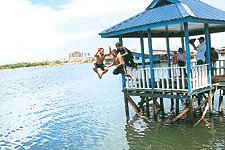
Boys jumping into the water during
bath-time at Labuan's Water Village.
Media personnel and guests having a
Malay-style lunch at Kg Patau-Patau 2.


Media personnel and guests walking along
the wooden bridge to Kg Patau-Patau 2.


Photos by: Achong Tanjong ; Copyright © 2006 Brunei Press Sdn Bhd.

By Achong Tanjong in Labuan

I recently got the opportunity to visit for the first time Kampung Patau-Patau 2, which is popularly known as Labuan's Water Village.

It is not as large as Brunei's Water Village but it boasts the unique cultural heritage of the Brunei Malays. Their daily life is similar to that of Kampung Ayer in Brunei. A majority of the residents of Kampung Patau-Patau 2 are Brunei Malays who still have very close family ties with the Malay community in Brunei.

Kampung Patau-Patau 2 is provided with pipe water, electricity, telephone lines and other facilities. There are also mosques, schools and canteens in the villages.

A majority of the villagers still depend on fishing to earn a living, especially the older generation. The younger people mostly work elsewhere and some even hold important positions in the government and private sectors.

But what surprised me and the other Mega FAM guests was that the surrounding waters were very clean and free of floating household rubbish. The water was calm and quite free of water-taxi boats.

We saw young children jumping into the water to take their bath. Walking along the wooden bridge that links the "mainland" to the village, we saw fishing boats and people repairing their fishing nets in the corridors of their houses.

Our arrival at the parking lot of the village was greeted with a Malay traditional welcome - the beating of "Hadrah" and "Bunga Rampai".

Our lunch at Kampung Patau-Patau 2 was hosted by the Persatuan Nelayan (Fishermen Association) and held at the house of Awg. Adillah bin Arsat, aged 27. He said there are about 100 houses in Kampung Patau-Patau 2 with a population of more than 1,000 people, most of whom are full-time fishermen.

Seven of the houses in the village are involved in a "Homestay" programme, which is run by the Ministry of Tourism Malaysia with the cooperation of Fishermen Development Authority to promote eco-tourism.

Awg. Adillah said since the programme was introduced, Kampung Patau-Patau 2 had received an overwhelming response not only from domestic visitors such as from Sabah and West Malaysia but also foreign tourists such as from Japan, Korea, China, Thailand and Indonesia.

Under the programme, the tourists experience the daily life of fishermen. The activities arranged include fish processing, making of salted fish, catching crabs and cooking a fresh catch for lunch or dinner.

The visit was one of the media activities held in conjunction with the Labuan International Sea Challenge 2006. The media were invited by Tourism Malaysia.

Other places of interest in Labuan visited by the media included The Chimney, Bird Park, Peace Park/ Japanese Surrender Point, War Memorial II, Marine Museum and Labuan Museum.

Courtesy of Borneo Bulletin