Showing posts with label North Borneo Railway. Show all posts

Thursday, August 31, 2017

Janice Horton: Adventures in Borneo - Kota Kinabalu and The North Borneo Railway


There are two distinct sides to Malaysia. West (Peninsular) Malaysia and East (Borneo) Malaysia and they are separated by the South China Sea.

Trav and have explored most of the Malaysian peninsular including the islands of Penang and Langkawi on the west side and Perhentian Islands on the east but up until now we haven’t ever ventured across to Malaysian Borneo. That all changed when we flew from Kuala Lumpur to the town of Kota Kinabalu.

Kota Kinabalu or KK is known is the capital of the northern part of Borneo and is the gateway to the Kinabalu National Park.

Many people come here to climb Mount Kota Kinabalu – but not us – we were here for a train ride!

Riding on the North Borneo Railway is like stepping back in time and travelling through towns and jungle in the heart of Borneo on one of the very few wood-fuelled engines left in the world today.

Originally manufactured by the Vulcan Foundry in Newton-le-Willows Lancashire UK and part of a fleet that have plied the tracks through Borneo since the late 1800’s.

We had the most amazing day travelling on this fabulous old steam train re-living the by-gone era of old colonial times.

.
.

Wednesday, March 22, 2017

Melalap railway station building to be preserved as National Heritage


TENOM: Deputy Chief Minister Tan Sri Joseph Pairin Kitingan said the old railway station building in Melalap here would be preserved as a National Heritage.

He said this was to preserve the historical building for future generations.

“We agree with the museum to preserve and ensure the old building will become an attraction,” he told reporters after visiting the site of the Melalap railway station here on Monday.

He said the station was closed in 1971. The railway in Melalap was a major communication system for people who wanted to go Jesselton (now Kota Kinabalu) via the Tanjung Aru station.

Pairin said the effort would also attract more local and foreign  tourists to Tenom and would bring an impact on socio-economic development of the local communities in this area in the future.

Tuesday, September 27, 2016

CuriosTraveller: North Borneo Railway Part 2 - The Experience


It left our beloved civilization, from the concrete jungle into the real green jungle.  It went through some villages, mangroves, jungles and plantations until it reached a small town where the locals were a bit slower in doing things in comparison to those in state capital. They looked pretty happy with what they are doing daily. We both kind of loving that way of life, free from the city’s stress. There’s no massive traffic jam here.

Local kids were excited to see the train coming, waving hands as if they are mates of us. We saw them waved again during the return trip. Did they actually wait? Welcome to North Borneo Railway, Arman said to us and we wish you the same, a great service by Sutera Harbour Resort & Sabah State Railway Department.

Pre-departure

That beautiful and sunny morning of September 24, 2016 we found ourselves checking in for the train ride, a return same day trip to Papar from Tanjung Aru Station. Checking in was easy, thanks to Linda who’s also one of the crew serving passengers. We’re excited like kids getting that passports, a mini booklet actually where a crew will stamp the destination names.

Then there was Dg Sarimah standing at the entry point, sincerely smiling all the time. She quickly assigned us to the seats in Tanjung Aru carriage or unit, if we may say that. The experience began even before boarding. The team were readily available to personally escorting each passenger to his or her seat.

At the Boarding area there’s Arman, who continuously smiled, sincerely to each arriving passengers! The passengers couldn’t stop smiling as well, a sign that they were pretty pleased with such great attentiveness given to them. It’s pretty mind blogging how each crew was able to escort each passenger to the designated unit when actually more passengers coming at the entry point. None of them waited long enough, soon after arriving they were whisked away to their seats in respective carriage, in record time!

We’re amazed with the carriages, both the interior and exterior. Inside our Tanjung Aru cariiage, beautiful decorated seats with darker wood panels as the wall pretty much implying the luxury feel, a perfect combination between new and old refurbishing style. The rotating ceiling fans gave cool air to the entire coach. Wall lights cleverly installed at each side of the window panels. The brand’s logo neatly carved on smaller metal pieces, embedded on each seat.

The exterior has the right colors that resembles the olden days train, green and white with the logo on each carriage. Inside, the unit we were in was pretty immaculate, there’s not even one microscopic litter can be seen, looks like the crews did their job perfectly, looking after the train cleanliness inside out. Everyone were here and there, inside and outside the train, capturing moments through the camera lenses. Nevertheless, crews managed to assemble all back into the units so that they can start the service with pre- departure safety presentation followed by serving refreshing lemonade.

Overall, pre-departure service was excellent. Crews were very professional in handling passengers arrival. While crew ensured passengers safety and comfort, they did it soulfully, with all their heart,  in full smile which in return made the passengers smiled. Not a single complaint heard, at least in our carriage.

The Train Master, Mr Jual Husin, went around ticking the boxes in his check list. He ensured each passenger comfort and in full-swing, ready for the journey. Having completed his round in all 5 carriages, he proceeded with the thumbs-up for that harmonious sound of whistle and bells, an indication that the train is ready to leave Tanjung Aru Station.

.
.

Monday, September 26, 2016

CuriosTraveller: North Borneo Railway Part 1- About and History


No other experience on other train service is able to beat our experience being on board the North Borneo Railway. The experience will last forever in our thoughts. Yes, this is not the Eastern & Oriental service but this service is in North Borneo, Sabah Malaysia, it’s a ride on a classic train. Not the Shinkansen or bullet train as in Tokyo to all over Japan either but the return trip to Papar from Tanjung Aru station by North Railway Borneo took us to the ‘past’. It made us understand one big thing, the history. It made us ably to appreciate all the elements of a classic train by just being on a single ride! A ride of a lifetime that we strongly recommend to all of you, without any hesitation, not even a second!

Prelude

We are truly grateful and shall be sharing all our experience so that you will be inspired and hop on the train service by North Borneo Railway soon! If you do, please do contact us and share your experience in this blog! We love guests post anyway! After all, sharing is caring. The ride is not about indulging in luxury, it is about ‘visiting the past’, enjoying that amazing views, making friends with the other passengers, capture all that beautiful landmarks (for photographers), moving at a slower pace as how the older generations did during the British era and perhaps waving hands to all the people outside (they are excited too!).

About

Credit: Sutera Harbour Resort & Sabah State Railway Department

North Borneo Railway is the oldest running steam train in Sabah and Borneo. The nostalgic romance of an old steam train relives memories of a bygone era. Passing through villages and coastal towns, paddy fields, rainforests and plantations of rubber and coffee, a ride on North Borneo Railway is truly a journey of rediscovery into the heart of Borneo.

The North Borneo Railway is a joint venture project between Sutera Harbour Resort and the Sabah State Railway Department (Jabatan Keretapi Negeri Sabah), signifying a historical collaboration between the private sector and the state government. The primary goals of the project are to enhance existing infrastructure as well as help in efforts to promote Sabah as a destination for domestic and international tourism. The North Borneo Railway was officially launched on 22nd January 2000 in honour of Kota Kinabalu achieving city status on 2nd February 2000.

The North Borneo Railway offers passengers an opportunity to experience the bygone era of British North Borneo while transporting passengers along the lifeline of Sabah. Refurbished to recreate the nostalgic romance of people travelling by steam train in the days of the Chartered Company and the British Colonial Office, both the exterior and interior provide an environment that would have been typical of stepping onto a train in the 1900s.

The exterior utilizes the traditional deep green and cream of the original North Borneo Railway, with carved brass logos showcasing the original design of a tiger holding a rail wheel, standing on the royal crown.

The interior highlights the natural woods of Sabah and unless the train is fully booked, passengers are offered free seating on one of the five colonial-style passenger train carriages.

The Vulcan’s Origin

Credit: The Engine Museum (United Kingdom) & Sutera Harbour Resort

The steam locomotive from the North Borneo Railway was manufactured by the Vulcan Foundry Ltd in Newton-le-willows in Lanchashire, United Kingdom. As quoted from the Engine Museum in the UK:

“Vulcan Foundry received its final order in 1954 from the North Borneo Railway for three locomotives-the result a neat 2-6-2 tender locomotive of 58'-0? length, weighing 85 tons.”

Not only do these steam engines represent the last of a fleet that have piled the tracks through Borneo since the late 1880’s, they are also part of the only few functional wood burners in the world.

.
.

Friday, December 11, 2015

Why not to skip Kota Kinabalu: 7 reasons to stick around Sabah’s capital


Often just a transit stop for travellers headed to the wild jungles and pristine coral reefs of eastern Sabah, Kota Kinabalu offers much to those who decide to stay on – from fantastic seafood to tropical island-hopping, orangutan encounters to a steam train ride into a bygone era.

Just a short hop from Kuala Lumpur, and a mere 40-minute flight from Brunei, Kota Kinabalu (KK) also makes a great case for tying in a stopover within a stopover if you've already visited Southeast Asia's major flight hubs and are keen to break up a long international flight in a new destination. Read on for seven great ways to make the most of it.

Soak up the city sights

One of Malaysia’s fastest-growing cities, sprawling Kota Kinabalu is no longer easy to picture as a British colonial trading post. But with just three buildings surviving the 1945 Allied bombings (including the Atkinson Clock Tower, the post office-turned Sabah Tourism Board headquarters, and a welfare office, which, after being razed by fire in 2002, has become an unofficial street art gallery), one can hardly blame it. But while business booms in KK’s office blocks, day-to-day life thrives at street level much as it always has.

By the waterfront, KK’s Central Market is a feast for the eyes, if not the stomach. Hawking everything from exotic tropical fruits to prawns the size of small lobsters, this wet and dry market is open all day, every day, and makes for great photo opportunities. Wander south, and you’ll hit the colourful Handicrafts Market – perhaps the best place in Sabah to pick up inexpensive textiles, pearls and other souvenirs.

Eat, eat, and eat some more

KK’s rich ethnic makeup has birthed one of the most diverse culinary scenes in Southeast Asia. Unsurprisingly, seafood is king here. Head to Welcome Seafood Restaurant (wsr.com.my) for one of the freshest, most affordable seafood feasts in town – simply point to what you want in the tanks and indicate your cooking style (hint: try the curry crab) and it’ll be on your table in minutes. Worth forking out a little more for is a meal at Alu-Alu CafĂ©. Don’t be fooled by its modest surroundings; here, seafood sourced from Borneo Eco-Fish, an organisation dedicated to harvesting and distributing seafood from sustainable sources, is prepared with modern Chinese-style finesse.

From Indian to Italian, you can find it all in KK. But if it’s hawker food you’re after, head to the city’s famed Night Market to take a culinary tour of Malaysia, or jump in a taxi to Lido Square, a newer, more local food market in the suburb of Penampang where you can feast on everything from mouthwatering gou tie (pork dumplings) to the perfect Kuching laksa for next to nothing.

Ride the North Borneo Railway

Built in 1896 to transport tobacco from Sabah’s interior to the coast for export, Borneo’s first (and still only) railway was all but destroyed during World War II. In 2011, the North Borneo Railway finally reopened, complete with a retrofitted locomotive offering tourists the chance to experience its most scenic section, turn-of-the-century-style. Leaving from Tanjung Aru, just south of KK, the iron horse chugs past lush paddy fields and traditional stilt villages before arriving in the town of Papar. The four-hour round trip includes breakfast, a smashing tiffin lunch, and stops at Kinarut, with its serene Chinese temple, and Papar, which has a colourful produce market worth checking out. Tours depart on Wednesdays and Saturdays, but be sure to check ahead if the train running; the old girl is temperamental.

.
.

Monday, July 20, 2015

They have trains in Borneo?


After thinking Borneo was all jungle and wildlife, I decided to take a day trip from Kota Kinabalu and went full steam ahead on the North Borneo Railway!

The line begins at Tanjung Aru and continues all the way down to Tenom, nearly 140km away.

This is a nice area for tourists with lots of cool natural and historic attractions, and I found lots of friendly people in Papar, too.

That is becoming the norm in Malaysia, as everybody seems so friendly here towards tourists.

The future of the railway has also been brightened by the increasing use of it by tourists.

The Beaufort to Tenom stretch of track runs through the Padas River gorge and is regarded as incredibly scenic.

In addition the railway itself is something of an attraction to some, and a historic North Borneo Railway tourist train is operated by Sutera Harbour Resort especially to capture this market.

With the growth of Sabah as a “light adventure” destination, the use of the railway by tourist traffic is quite likely to increase.

Continue reading (Incl. Pics) at: They have trains in Borneo?
.
.

Tuesday, April 01, 2014

For the Love of …. The NORTH BORNEO RAILWAY


Last week, I flew across the South China Sea, to catch a train.

Not just any ordinary train, but the Vulcan steam locomotive … and a mighty fine hunk of steel to ride on! Heh.

I love trains, and yes, I do jump up and down at the sight of them when no one’s looking... I don’t know much about the mechanics, but what I do know is that this particular ride is a heritage in its own right, one not to be missed. 

To hear the whistles blowing as the massive locomotive goes chug-a-chugging through the countryside got my heart bouncing around like a big ball of happiness and my face permanently plastered with a sloppy grin from start to finish!

Everything about this special train ride is either old or old-fashioned.

The vintage locomotive runs on the North Borneo Railway tracks which dates back to the 1890's (when the British colonists decided that building railways was the best way to tap the rich resources of Borneo).

It draws 5 Kawasaki-designed carriages that were built in the 70's. Both the exterior and interior were modified to reflect the era of the steam train. In each carriage, passengers are seated in comfy diner-styled seats, with opened windows and ceiling fans to enhance the overall heritage experience.

Buying tickets and boarding the train at Tanjung Aru Station was in itself a step back in time of the bygone era. Passengers are greeted by a bevy of station staffs, all smiling widely and proudly, in their colonial-style uniforms: crisp white shirt over khaki shorts, complete with a planter’s hat!

Continue reading (Incl. Pics) at: For the Love of …. The NORTH BORNEO RAILWAY
.
.

Sunday, August 25, 2013

Down Memory Lane - Sabah Railway Train


It was my dream to visit the Sabah railway station in Tanjung Aru to inquire about the travel schedule to all it's destination but instead asked my nephew who is also interested for the travel trip on the train.

A friend was promising me for the trip for awhile but there was no indication of him going for the trip so I decided to suggest it to my family members and they were indeed very eager especially the young ones.

It was therefore suggested that the coming Saturday was chosen as it was also the last of the school holiday.

We chose for the earliest trip that was at 7.40 am and  make sure that all of us must be at the station at 7.00 am.

As we were looking forward to the trip, there was no problem of waking up early.

I was once again a young kid telling all the first timer of the thrill travelling on a train.

There was no problem parking your vehicles there as there were ample parking lots as you are taking the return trip in the afternoon.

When we reached Tg Aru Railway station, there were a lot of people mostly seated with their travelling bag and maybe cookies or Raya delicacies inside the bag and boxes.

As a first timer to the station I went directly to the counter but nobody was manning the counter.

I was surprised as the travelers stood up behind me to make a queue. (Ikut Barisan bogia lol ...)

They thought that I was there for the queue and since they stood behind me why not stay put instead of going at the back of the queue.

While waiting for the counter staff to open I spoke to a lady about the train and the railway route.

Continue reading (Incl. Pics) at: Down Memory Lane - Sabah Railway Train
.
.

Thursday, July 25, 2013

The Magic of Light at Weston River


Sabah has many beautiful places which are only reserved for people actively seeking for them. I noticed Weston when I saw many stunning sunset photos of Weston being shared everywhere on Facebook and Twitter. That’s why I traveled 125 Kilometers from Kota Kinabalu to Weston town last month, to see the magical moment with my eyes. However, I find more interesting things than a nice sunset.

Weston the Historical Town

Named after a railway engineer, Arthur J. West in 1889, Weston town was an important meeting point for trains and ships, due to its strategic location back in the old days of British colony era. Today it becomes just another “remote” Sabah town between Beaufort and Sipitang. Few knows that Weston is the town which North Borneo Railway first constructed.

Probably one of the oldest wooden school of Borneo, Che Hwa school is a two-storey building constructed in 1932, and funded by donations from timber tycoons, charcoal merchants and shopkeepers of Chinese community*. In 1930s, many Chinese lived in Weston, the period when Weston was a key hub. Now this school has only 5 teachers and 7 students.

Weston River was used to be called “Jump-Jump” River because of the mudskippers here. In late afternoon, you would see many villagers gather around the boardwalk, fishing and playing RC speedboats there.

British government abandoned Weston port when they learnt that the shallow water of Weston is unfit as a deep sea wharf. Now this jetty is a favorite spot for local anglers.

Weston Jaafar River Lodge

The lodge is a 2-storey wooden building built on riverside and surrounded by dense Nypa palm (or Nipah). Nipah swamp forest, which has existed over 70 million years, is one of the oldest forest type in the world.

River Safari & Wildlife

It was around 5pm after we were done with tea break, everyone couldn’t wait to start the river cruise. The cool thing about wildlife sighting here is – we don’t even need to move our legs to look for animals.

Weston River is part of the largest wetland (Klias Peninsula) in Sabah. Wetland is a generic term that covers different aqua-ecologies such as coastal areas, river, lakes, mangrove, peat swamp, nypa swamp, etc., and it is the important habitat for some endangered Borneo wildlife such as Proboscis Monkey.

Very soon our guide spotted a saltwater crocodile taking a nap on the muddy river bank. It is about 3 Meters in length.

Couple of months ago, a 1-Meter crocodile was found in city drain and made news headline. Haha, compared to this beast, that city croc looks more like a gecko. FYI, crocodile never ceases growing throughout its life, it can reach massive size if it lives long enough.

Continue reading (Incl. Pics) at: The Magic of Light at Weston River
.
.

Wednesday, June 05, 2013

North Borneo Railway


Today was a day of two halves but I'm going to focus on the first half. While I am happy to lounge by the pool and walk on the beach and eat towering banana sundaes, those days of simply 'doing nothing' are far far behind us.

Now we need to factor in the interests of our young man - and his main interest is trains. When Kota Kinabalu was just on a list of possible vacation spots and I was looking up the possible things to do here, I found the North Borneo Railway train ride. The perfect fit for my train crazy child.

It runs twice a week, this dramatic steam train from the late 1800s and is a chance to venture into the Borneo mangroves from the comfort of your seat. We booked in advance as advised and left the confines of our beach haven to drive an hour back into KK.

At the station we exchanged our email confirmation for 3 quaint passports and tickets and boarded our beautiful carriage with its wooden interiors.

Then we disembarked to watch the steam engine reverse into position and couple up to the 5 carriages. It was highly exciting for a 3 year old - we even had moments of stunned silence.

Once we chugged out of the station it was about an hour and a half journey to the end point with one 20 minute stop in between in a non descript village. The final stop was half an hour in another non descript place of small grocery shops and dark coffee shops.

A tiffin box lunch (which sounded far better than it tasted) was served on the return journey, set up after that last stop. I'm glad we had had a good breakfast because really, only the fruit box was edible.

The engine ran out of steam - hazards of old machinery - and with the firebox needing to be stoked we were delayed about 20 minutes on the return. The scenery was interesting but not spectacular - water buffalos, mangroves, rivers and seaside featured prominently.

Continue reading (Incl. Pics) at: North Borneo Railway
.
.

Friday, April 19, 2013

Sabah Fest to feature North Borneo’s railway engine


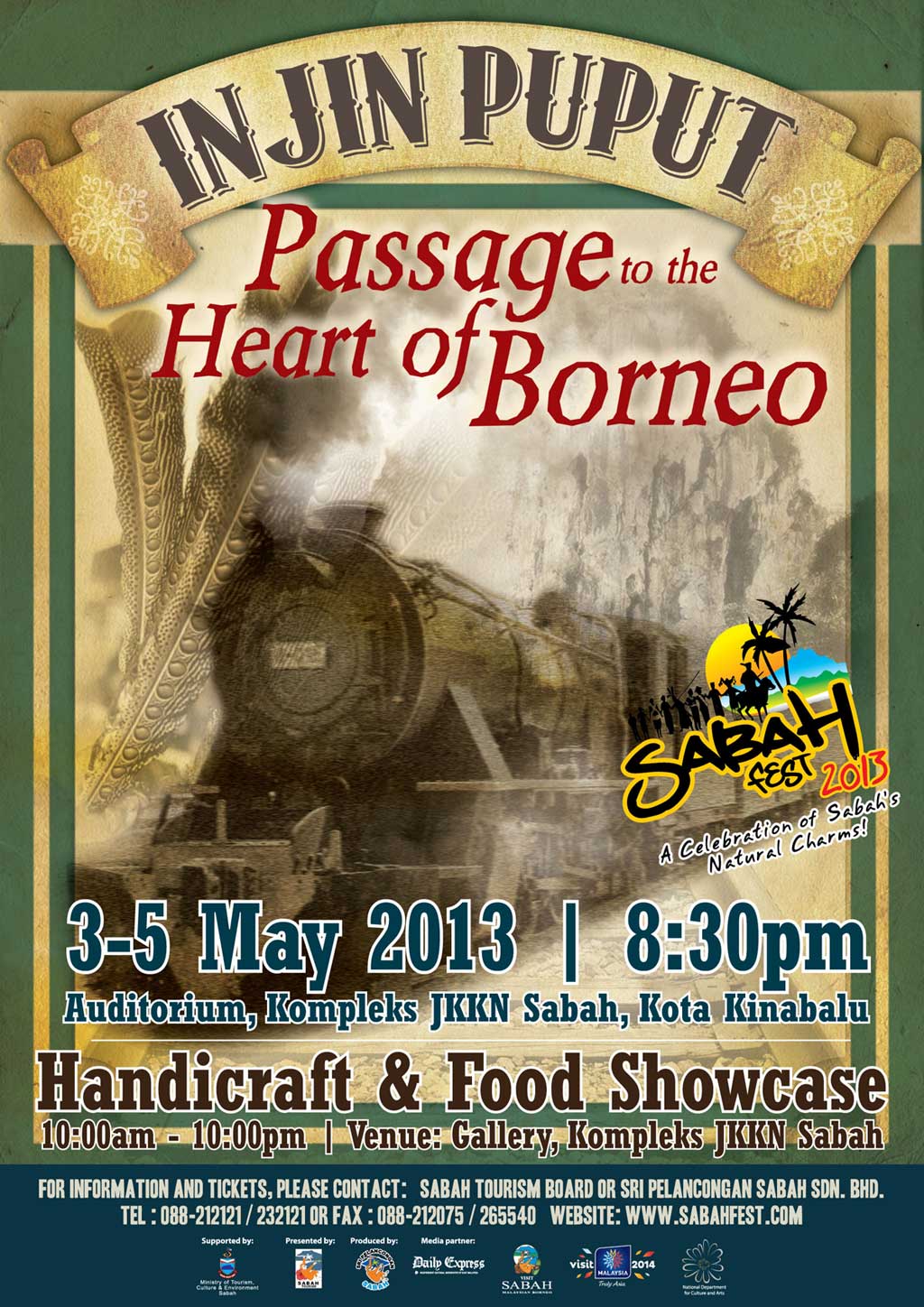
KOTA KINABALU: Featuring North Borneo’s railway engine or locally known as ‘injin puput’, this year’s Sabah Fest cultural extravaganza will take its audience through a passage to the heart of Borneo.

Set to be held for two days from May 3 to 4, which had been cut short from three days to give way to the 13th general election, Kompleks JKKN Sabah has once again been chosen as the venue for the musical performance, starting at 8.30pm.

“Injin Puput – Passage to the Heart of Borneo, will bring audience to reminisce the good old days when the North Borneo Railway steam train was still a huge part of Sabah, the only such technology available in this part of the world back then,” said Minister of Tourism, Culture and Environment, Datuk Masidi Manjun, at a press conference yesterday.

Telling the story of Aki Guonun, a Murut warrior in love with Mei Ling, a woman from a cultural background alien to his, audience on board the Injin Puput musical performance are bound for a cultural feast as they follow the story of the lovebirds.


“It’s going to be a unique cultural experience as it ‘moves’ from one district to another, along the North Borneo Railway route. The audience will get the chance to learn some of Sabah’s rich cultural heritage, some of which are even bygone,” said Masidi.

The roles of the hero and heroine of the play, which casted about 400 local performers, are set to be played by local artistes, Janrywine and Brenda Londoh.

Masidi also disclosed that four new songs had also been written and composed for the 100 per cent locally-produced musical performance, with another song hoping to be completed before the date of the event.

.
.

Friday, November 16, 2012

North Borneo Train: Melalap The Final Station


In some parts of the interior of Sabah, train still serves as the main transport for people to get around. Just to name a few train main stops like Saliwangan Baru, Halogilat, Rayoh, and Pangi along the Beaufort-Tenom route are the places which depend solely on train service. In the old days, the North Borneo Train spanned it service starting from Jesselton to Melalap as its final station.

According to history, the Tenom-Melalap route was opened in 1906. And was closed in 1970.

Back in 1975 to 1976, the station was used as Melalap Police Station. It served as a quarters at the same time. If I am not mistaken a policeman and his family lived there during the period. I was in Primary One then. I remember studying in the same class with the policeman son until Primary Two at a school nearby, SK Melalap.

A row of shophouses building is located nearby. The building is as old as the railway station. Even though it has aged but still home a couple of families who run the sundry shops. The are two shops still operating. One is long closed in the late 1990s.

In the past, there used to be a Tamu (market) on Saturdays. The town folks came out with farm produce to sell in exchange for a packet of sugar and coffee. Fish mongers from Tenom came up with salt water fish. It was the day that everyone waited for.

During that time, RM 1.00 for a Land Rover ride from Melalap to Tenom was considered too much to afford. The Tamu then slowly forgotten as most of the new generation work at the government offices in Tenom. Who would want to buy at the Tamu when they could get supplies from Tenom as they wish for daily? Soon after, Melalap has turned out to be a quiet town.

Continue reading (Incl. Pics) at: North Borneo Train: Melalap The Final Station
.
.

Thursday, October 11, 2012

Rail-ly memorable North Borneo train ride to Beaufort


OUR original intention was to board the famous North Borneo Railway and follow the heritage trail from Tanjung Aru to Papar, 38km from Kota Kinabalu.

However, fate had a weird sense of humour because on arrival in the capital of Sabah, fondly called KK (previously known as Jesselton), a call came from the Heritage Train organisers to tell us that the Heritage Train engine had broken down and it’s in the workshop.

With a heavy heart, we had to resort to Plan B. Two days later, we unanimously voted to board the Sabah State Railway and make our way to Papar.

On hindsight, this actually lessens the strain on our purse-strings by more than RM268 per person because the fare to Papar by the regular train is only RM1.85 per person one way.

The fare on the North Borneo Railway, with all its bells and whistles, was RM270 to Papar and back!

CHUGGA-CHUGGA CHOO-CHOO TO PAPAR

There are 15 stops from Sekretariat station to Tenom. Since we boarded at Tanjung Aru, there are only three stops to Papar.

It’s nice to re-acquaint ourselves with the kind of coach which we have not seen for a long time. The Sabah railway looks slightly similar to the KTM but there are fewer coaches because there are simply fewer passengers.
The interior is spacious and the colour of the seats is similar to the ones we have back home.

A friend from Sabah tells me that the State railway is the chief means of transport for those living in “reduced circumstances”. City people tend to prefer buses, mini-buses and taxis when they travel from town to town.
Locals can easily tell we’re not one of them since we sound very much like people from across the South China Sea, meaning the peninsula.

I draw some curious looks because the locals aren’t quite so sure about my identity since I am wearing a Javanese cap. I eavesdrop on a nearby conversation and hear a passenger remarks “macam orang Jawa”.

The first thing we notice before the train leaves the station is that the ceiling fans in our coach aren’t working. But when the train finally moves, the fans start spinning. Well, at least half of them do.

 The rail route is along the west coast of Sabah and it faces the South China Sea. Without any expectations, we are happy that marshlands soon loom into sight and along several sections of the route, swamps appear right next to the track.

Kampung houses are common but not many. The land is very flat and the atmosphere bespeaks of pastoral surroundings that are dissimilar from those in the peninsula.

After 30 minutes or so, we reach Papar, a town with a population of about 128,000 (2010 statistics). The residents comprise Kadazandusun, Bruneian Malay, Bajau and Hakka Chinese.

I find out later that the name Papar means “flat” or “open land”. The main agricultural crop is rice. Naturally, padi fields are found in abundance but in recent years, orchards have also sprung up.

CHICKEN GEORGE

The passengers who board the train at Putatan, Kinarut and Kawang (between Tanjung Aru and Papar) are mostly villagers and teenagers.

One of them, a young lad, has brought along a “friend” who attracts some curious looks when it begins squawking. It’s actually his chicken which is wrapped in a plastic bag with its head protruding out.

While some of us cast furtive glances at him, the boy who we nickname “Chicken George”, retreats to a secluded corner between two rows of seats with his feathered friend resting on the floor.

Every time the chicken squawks a little, he taps it gently with his foot and it stops. I am hoping that it is his pet and not headed for the pot.

This scene would have been common in pre-war Malaya on local trains. I reckon that if someone had brought along his pet goat, I would have gladly offered my seat to the horned guest. After all, it is the only decent thing to do since I am only a guest in the Land Below The Wind.

L.P. BEAUFORT NAMESAKE

Since Papar is insufficient to satisfy our sense of outdoor adventure, we proceed to Beaufort, 52km from Papar and 90km from Kota Kinabalu.

What we will do in Beaufort is as much a mystery to us as it is to the train conductor when we pay for the extended rail journey to a town in the interior named after L.P. Beaufort, a former British Governor.

Then, 45 minutes later, we glide to a gentle halt at a very quiet provincial town which has a population of 76,000. The townspeople, mainly Chinese Hakkas, are either having their siesta or closing their businesses early.

.
.

Monday, February 13, 2012

Atkinson Clock Tower Exhibition a hit

KOTA KINABALU: The Atkinson Clock Tower exhibition at Hotel Sixty3, Gaya Street here, in conjunction with the recent ‘Bonding With Gaya Street’ event has proven to be such a hit among locals and tourists that the exhibition has been extended until February 14.

The exhibition venue is located at the hotel’s first floor atrium, situated just opposite the Sabah Tourism Board building.

Among the highlights of the exhibition is a 48-foot long graphic mural of the Atkinson Clock Tower, sponsored by Hotel Sixty3 as well as numerous images and information of Kota Kinabalu’s oldest and most popular city landmark.

According to Richard Nelson Sokial, a local heritage advocator involved with the exhibition, the public response to the Atkinson Clock Tower exhibition had been very good, and by popular demand, the hotel’s management had kindly extended its goodwill and hospitality to host the exhibition for another two more days.

Curious members of the public have come steadily since Saturday to view the exhibition, which is one of the activities organised by the North Borneo History Enthusiasts (NBHE) for the recent ‘Bonding With Gaya Street’ event. The exhibition was put together by members of the Heritage Sabah group with the help of NBHE volunteers and the cooperation of Sabah Museum, Sabah State Archives, Sabah Information Department, town planning studies by AIA Consortium as well as photo contributions from private individuals.

Besides displaying rare photos showcasing the importance of the Atkinson Clock Tower as a city marker for more than 100 years, the exhibit features a 100-year old original railway sleeper used by the North Borneo Railways (now known as Sabah Railways), courtesy of Cap Kuda Coffee Company. A visual multi-media display by various supporters of Heritage Sabah group’s Save Our Heritage Atkinson Clock Tower campaign is also on display which shows the younger generation’s appreciation of the clock tower as a legacy for their own generation in Sabah.

Continue reading (Incl. Pic) at: Atkinson Clock Tower Exhibition a hit
.
.

Sunday, February 05, 2012

North Borneo Railway steam train service back on track again

Kota Kinabalu: The North Borneo Railway steam train service is back on track after an absence of six years.

"This is the only one of its kind in South East Asia which I think Sabah should leverage on, said Tourism, Culture and Environment Minister, Datuk Masidi Manjun at the re-launching of the North Borneo Railway here, Saturday.

The North Borneo Railway is a joint venture project between Sutera Harbour and the Sabah State Railway Department, which was temporarily closed in September 2005 due to the upgrading works of the railway track.

The three-hour train service will operate on Wednesdays and Saturdays from to Tanjung Aru and Papar.

Masidi said Sabahans should be proud that despite the developments and the modernisation of the transport industry, the State has somehow managed to save one of the last remnants of colonial transport.

"I believe that this is going to be a winner and be very popular among tourists just by looking at all the amenities and facilities that are served on board," he said, adding that it is very important that the standard of service is maintained continuously.

"I have always advocated that there are things in Sabah that we need to maintain for instance old shop houses in Tanjung Aru, which we need to strengthen the structure and convert into something that we can actually add value to what we already have.

"We have to keep in mind that development is not just about building tall buildings, its about the convenience of the people, you need to look beyond the building itself to appreciate what you are going to put into the city.

"If the city is congested with buildings, obviously traffic jams will follow next and at the end of the day, your intentions of wanting to enrich the city would actually backfire because people will stop patronising the city," said Masidi, adding that is why the same principle should apply to a product like this North Borneo Railway," he said.

Continue reading (Incl. Pic) at: North Borneo Railway steam train service back on track again
.
.

Monday, July 18, 2011

North Borneo Railway ‘Vulcan’ returns to offer rides down memory lane

KOTA KINABALU: The steam locomotive from the North Borneo Railway (NBR), featuring the British ‘Vulcan’, one of a few that is still functioning in the world is now back on track.

After being put into retirement in the 1970s after it was replaced by diesel and petrol-powered locomotives, the steam locomotive was relaunched in 2000, through a joint venture project between Sutera Harbour Resort (SHR) and the State Railway Department.

Today, the NBR provides two scheduled runs on Wednesday and Saturday, departing from the Tanjung Aru station to Papar town at 9.30am and returning at 1.40pm.

The train features five carriages named after all the five stations where it stops and it can carry a maximum of 80 passengers.

The route which covers 38.5km will take passengers from the Tanjung Aru station to Putatan and will make a 20-minute stop at Kinarut town before continuing the journey to Kawang and finally arriving at Papar town.

It stops in Papar for 30 minutes during which passengers can disembark to explore the town.

A ride on the Vulcan will certainly evoke nostalgic memories of a bygone colonial era of the late 19th century.

SHR director of marketing communications, Kattie Hoo said: “The train service was resumed on July 4, this year and the response has been encouraging as most of the passengers are our hotel guests, while some came after reading about it.”

“This is an old locomotive train and it has attracted people to come because they want to experience the ride as this is one of a few that is still functioning in the world. The people want to enjoy the natural beauty and the sights of the countryside which they cannot see in the city,” she added.

The steam engine train is operated by a five-member crew after a six-year break since 2005 to allow for the upgrading of the railway tracks.

Continue reading at: North Borneo Railway ‘Vulcan’ returns to offer rides down memory lane
.
.

Thursday, July 14, 2011

Twice weekly on steam locomotive ride to Papar

KOTA KINABALU: The steam locomotive of the hitherto North Borneo Railways brought 60 guests back down memory lane yesterday when it took a jaunt to Papar, about 39 kilometres from the state capital.

Launched as a joint-venture project between the Sutera Harbour Resorts and the Sabah State Railways Department in 2000, it aimed to preserve the historical significance through the run, while supporting the tourism sector in the state.

Commenting on yesterday’s run, the resort’s director of communications and marketing Kattie Hoo said, although the guests on the ride were mostly hotel guests, there were also some members of the public who were interested in the event and merely wanted to participate.

Hoo said, the train may well be the last locomotive in the world and as such it was an attraction not only to tourists but to locals as well.

According to her, the steam train which utilised wood as its fuel ensured a scenic ride for passengers at it brought them through villages and settlements that were still basically untouched by time.

“We started on July 4 this year and seats were fully booked which only goes to show that the response had been very encouraging so far,” she told reporters during the event yesterday to coincide with the train’s third run.

She expressed hope that the trend would continue and pick up more as it goes along.

Meanwhile, the train would be carrying out two runs weekly, on Wednesdays and Saturdays with five carriages.

It would leave the Tanjung Aru train station at 10 am and reach Papar at 11.45am.

Guests who take the package would be entitled to breakfast and lunch.

Continue reading at: Twice weekly on steam locomotive ride to Papar
.
.

Wednesday, July 13, 2011

Plans afoot to extend railway services to major towns in Sabah

SANDAKAN: The Ministry of Transport plans to extend the railway transport services to connect all major towns in Sabah.

In this connection, the ministry through the Sabah State Railway Department (SSRD) and the Malayan Railway Berhad (KTMB) has been carrying out short-term work projects to modernise the railway service from Tanjung Aru to Tenom spanning 133.7 kilometres as a precursor to linking the major towns in the state.

This modernisation work has been divided into two sectors, i.e. Sector 1 (Tanjung Aru to Kimanis) and Sector 2 (Kimanis-Tenom).

In terms of progress, modernisation works for Sector 1 has been completed in full whereas Sector 2 is 74.5 per cent complete. The modernisation work for Sector 2 is expected to be completed by March 2012.

This was the ministry’s response to the oral question raised by MP for Batu Sapi, Datin Linda Tsen Thau Lin in Parliament recently.

The short-term work projects to modernise Sabah railway services from Tanjung Aru to Tenom are among the efforts undertaken by the ministry to connect the major towns in the state. Plans to link the other major towns in the state will be implemented after the ongoing modernisation work is completed.

The ministry has taken note of a study conducted by the State Ministry of Infrastructure Development (KPINS) to have railway services connected to all major towns in the state and this study will be scrutinised and taken into account in the planning for the future railway services.

Continue reading at: Plans afoot to extend railway services to major towns in Sabah
.
.

Wednesday, June 29, 2011

North Borneo Railway Going Full Steam Ahead on 4th July 2011

On 4th July 2011, the North Borneo Railway featuring the British ‘Vulcan’ Steam Engine will be making its 1st run.

Visitors to Kota Kinabalu, Sabah Malaysia will be able to enjoy a nostalgic journey on this vintage steam locomotive, one of the few functional locomotives left in the world that is fueled by wood, in beautifully-restored, historic green carriages. This classic train is operated to the highest of international standards and is fully compliant with modern safety standards.

The North Borneo Railway is a joint project between the Sutera Harbour Resort and the Sabah State Railway Department to help enhance the existing infrastructure and to promote Sabah as a tourist destination. The North Borneo Railway was officially launched on 22nd January 2000 in honour of Kota Kinabalu achieving city status on 2nd February 2000 and it was temporarily closed due to the reconstruction of the track by the Sabah State Railway Department.

The steam locomotive, the last of a fleet of locomotives that once plied the tracks through Borneo since the late 1880s, was manufactured by the Vulcan Foundry Ltd in Newton-le-Willows in Lancashire, United Kingdom. In 1954, Vulcan Foundry received the final order from the North Borneo Railway for three locomotives that resulted in a neat 2-6-2 tender locomotive of 58’-0” length, weighing 85 tons.

Managed by Sutera Harbour Resort, the train has a capacity for 80 passengers accommodated in 5 colonial-period carriages, each with a capacity of 16 passengers, and is named after a town along the journey … Papar, Kinarut, Tanjung Aru, Putatan and Kawang. For special charter services, the passenger load may be increased up to 160 passengers.

Continue reading (Incl. Pics) at: North Borneo Railway Going Full Steam Ahead on 4th July 2011
.
.

Sunday, April 17, 2011

North Borneo Railway - Nostalgia back on track with steam locomotive

KOTA KINABALU: Fancy travelling back in time? Soon, visitors and locals alike will be able to experience the good old era of the steam locomotive when the North Borneo Railway resumes operation.

The North Borneo Railway, a joint project between the Sutera Harbour Resort and the State Railway Department to help enhance the existing infrastructure in promoting Sabah as a tourist destination.

The North Borneo Railway was officially launched on 22 January 2000 in conjunction with Kota Kinabalu’s elevation to a city on 2 February 2000, but its service was disrupted due to the reconstruction of the track by the State Railway Department.

The North Borneo Railway features a British ‘Vulcan’ Steam Engine number 6-016 manufactured by the Vulcan Foundry Ltd in Newton-le-Willows in Lancashire, United Kingdom and is the last of a fleet of locomotives that plied the tracks through Borneo since the late 1880s.

Comes July 2011, the steam engine locomotive, one of the few functional locomotives fueled by wood, will once again be plying these same tracks to offer passengers an unforgettable journey of rediscovery into the heart of Borneo.

The train has a capacity for 180 passengers accommodated in six colonial-time carriages that have been refurbished and restored to reflect the luxury of the era.

A kitchen car serves ‘Tiffin’ styled meals, highlighting an exotic blend of colonial and continental cuisine.

The railway, managed by Sutera Harbour Resort is operated to the highest of international standards and is fully compliant with modern safety standards.

Passengers on board the train will be able to take in the sights and sounds of the countryside, paddy fields, mangrove jungles and pristine coastal beaches as the train chucks along the tracks from Tanjung Aru to Papar and return to Kota Kinabalu after an hour-long sojourn in Papar, a small town famed for being the rice bowl of Sabah.

Continue reading at: North Borneo Railway - Nostalgia back on track with steam locomotive
.
.